First Contact: Preliminary Signature Survey of Erythra Ferris Moon, Orbit Log Chapter _04
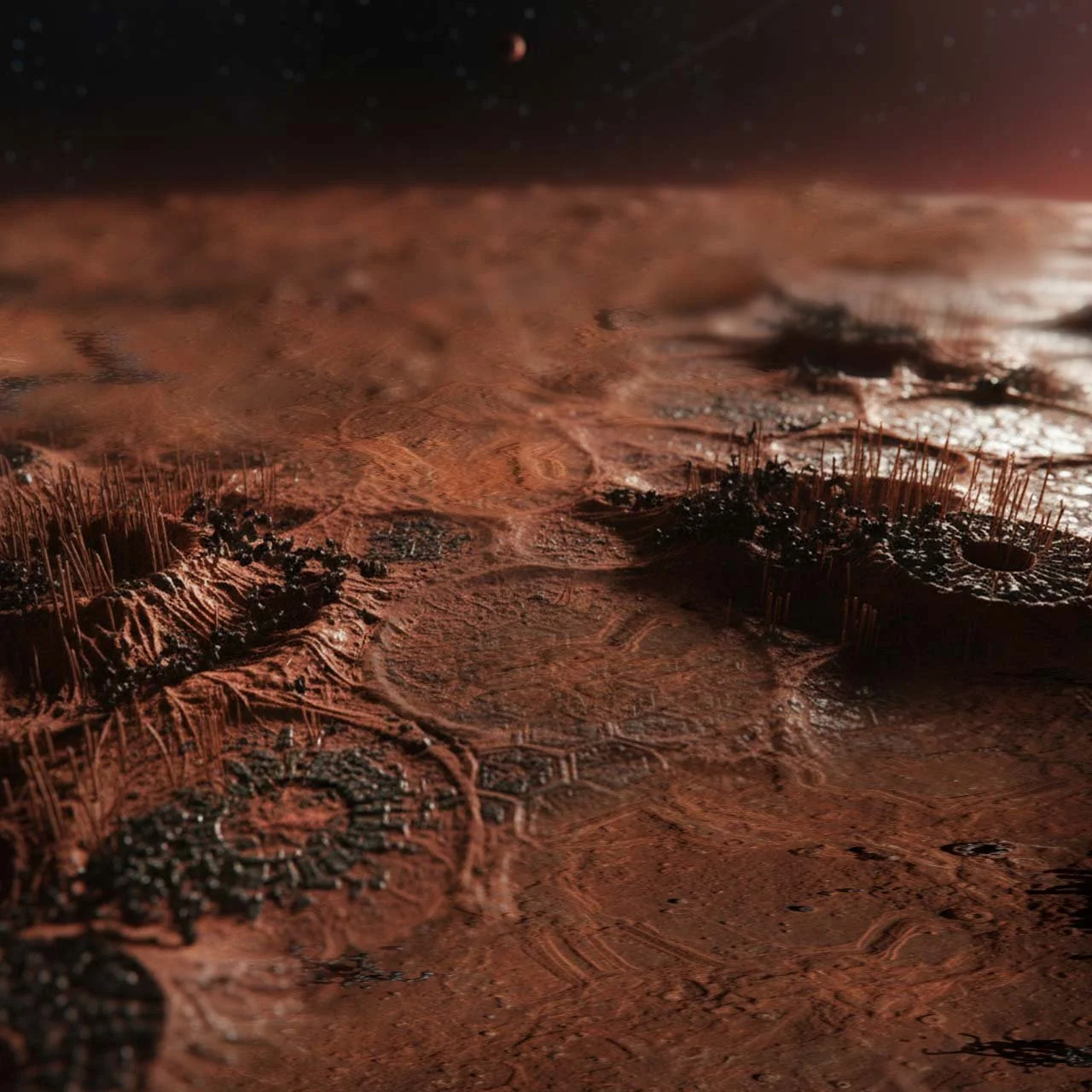
New spectral and high-resolution interferometric data from the third-generation James Webb Space Telescope arrays have revealed unexpected structural phenomena on Erythra Ferris, the primary moon of the exoplanet Aurigae-F b. This report summarizes the first assessment of these findings and outlines why Erythra Ferris now ranks among the most promising candidates for an alternative biochemical evolutionary pathway in our local region of the galaxy.
1. Geological Context and Geysir Dynamics
Erythra Ferris has long been suspected to harbor subsurface thermal systems due to its eccentric orbit and tidal stresses. The newest infrared mapping confirms multiple active geysir fields located along fractures within the moon’s ferric crust. Temperatures near vent openings remain within the theoretical band that supports the emergence of prebiotic chemistry.
On Earth, hydrothermal vents are known to create catalytic surfaces and thermal gradients capable of producing complex organic molecules. The first self-assembling peptides and primitive metabolic cycles likely formed in these unstable, mineral-rich environments. The chemical scaffolding was provided by iron-sulfur minerals that offered natural reaction chambers similar to biological enzymes.
Erythra Ferris presents this same pattern in far more extreme form.
2. Ferric Catalysis as a Foundation for Life
Spectroscopic data confirm unusually high concentrations of iron oxides and magnetite within the geysir basins of Erythra Ferris. Laboratory simulations on Earth show that iron molecules can act as scaffolding for chain-like polymerization even in the absence of carbon-based frameworks. The conditions on Erythra Ferris may therefore allow for a biochemical system where ferric molecules take the structural role that carbon plays on Earth.
This possibility suggests that life does not need to follow the “warm pond” or “carbon first” pathway at all. Instead, it may follow a ferric evolutionary line that builds stability, information storage, and metabolic processes directly out of metallic substrates.
Should this be confirmed, Erythra Ferris would represent the first evidence of a parallel evolutionary architecture in the known universe.
3. Unnatural Formations in the Geysir Regions
The third-generation JWST array returned an unexpected set of images from the geysir plains. These regions reveal cavities, repeating channel systems, and geometric hollows inconsistent with known non-biological erosion processes. The structures show:
Patterns that repeat in specific intervals that do not match water flow, wind erosion, or cryogenic fracturing.
Cavities that maintain uniform curvature despite variable surrounding terrain.
Linear micro-indentations aligned with no known magnetic or gravitational gradients.
Initial impressions strongly suggest long-term activity by an unknown life form whose biochemistry and behavior cannot yet be modeled by Earth analogs.
These findings are not yet presented as proof. Several rounds of data-cleaning are underway, with optical distortions, instrument artifacts, and gravitational lensing effects being systematically ruled out.
4. Implications for a Ferric-Based Evolutionary Tree
If the formations prove biological, they indicate an evolutionary branch entirely foreign to Earth. Ferric-based molecules may have formed proto-metabolic sequences energized by thermal gradients from geysir vents. This could create life that:
Stores information through magnetic or crystalline patterns.
Builds physical structures through mineral accretion rather than soft-tissue growth.
Adapts not through genetic drift but through shifts in metallic composition and charge states.
Such life would challenge every working definition of biology and may signal that the universe hosts multiple competing strategies for complexity. Carbon may be only one solution among many.
5. Pending Verification
We will publish a full structural analysis once all implausible signals have been removed. That includes calibration errors, rogue reflections from the Aurigae-F stellar environment, and possible interference from dust along the optical path.
Despite this caution, the data set carries a weight that cannot be ignored. Erythra Ferris may be the first world where we observe the footprints of a life form built from metal rather than molecules.
End of Transmission
Foundryon Universe Research Center